There’s a long list of things small business owners know they should handle and keep pushing back: updating the employee handbook, filing that quarterly report, sorting out the insurance renewal. Workplace first aid compliance tends to live on that list — somewhere between urgent and invisible — right up until someone gets hurt.
If you run a business in California with even one employee on site, OSHA-compliant first aid training in Long Beach and across the state isn’t optional. It’s a federal requirement with a California enforcement layer on top, and the gap between what most small businesses actually have in place and what the law requires is wider than most owners realize.
What Does OSHA Actually Require?
The federal standard lives in 29 CFR 1910.151 for general industry workplaces. The short version: employers must ensure that personnel trained in first aid are available if a medical facility is not in near proximity to the workplace. In practice, “near proximity” is interpreted as roughly three to four minutes’ travel time — a threshold that most workplaces, including those in commercial and light industrial areas, do not meet during an active emergency.
California operates under Cal/OSHA, the state-level enforcement plan that meets or exceeds federal OSHA standards. Cal/OSHA Title 8 regulations set out first aid requirements for employers and specify that first aid materials must be available and that at least one person per shift must be trained and available to render first aid.
This applies whether you run a five-person office, a retail floor, a warehouse, or a food service operation.
The Common Misconception About “Calling 911”
The most frequent justification small business owners give for skipping first aid training is that 911 exists. And it does — but 911 response times in a cardiac arrest situation are not fast enough to substitute for a trained bystander.
According to the American Heart Association, effective CPR started within the first few minutes of cardiac arrest can double or triple a victim’s chance of survival. Average emergency response times in urban areas typically range from six to twelve minutes. In a cardiac arrest, brain damage can begin within four to six minutes without intervention.
A trained employee does not replace emergency services. They buy time. And in a cardiac arrest, those minutes are the difference between a colleague who walks out of the hospital and one who doesn’t.
What “First Aid Trained” Actually Means
There’s a meaningful difference between someone who vaguely remembers a health class and someone who holds a current, recognized certification. OSHA does not issue certifications or approve specific providers — that’s a common misunderstanding. What OSHA and Cal/OSHA require is that training be provided by a qualified instructor and that the content be appropriate to the hazards present in the workplace.
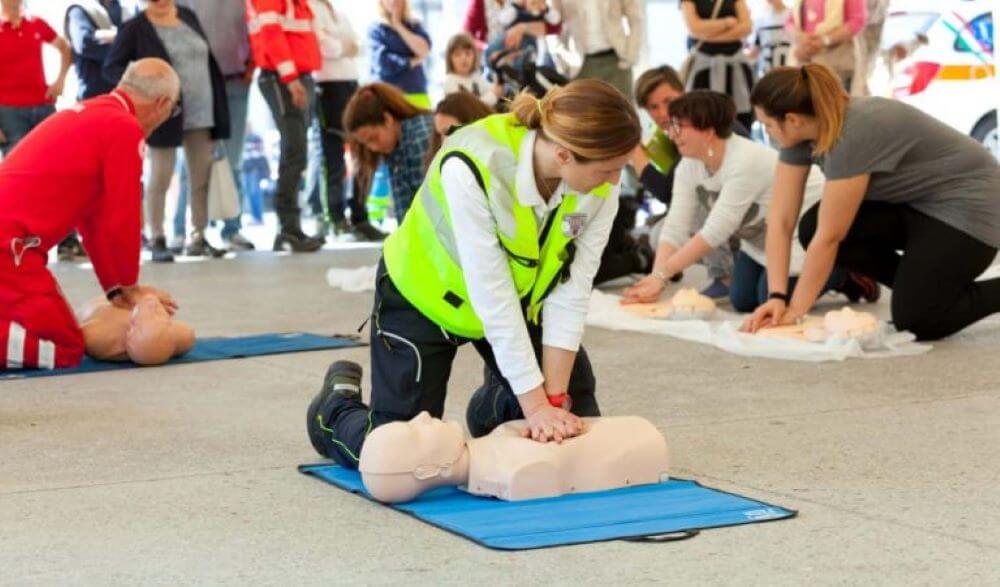
The American Red Cross and the American Heart Association are the recognized certifying bodies in the US. A Standard First Aid and CPR/AED certification from either organization satisfies regulatory requirements and gives your designated employee the skills to respond to cardiac emergencies, choking, serious bleeding, and other acute medical events until professional help arrives.
Certifications are valid for two years. Blended learning formats — online theory completed at the employee’s own pace, followed by a one-day in-person skills session — make scheduling realistic even for small teams with limited availability.
The Real Cost of Non-Compliance
Cal/OSHA penalties for first aid violations vary by classification. Serious violations — those where there is a realistic probability that death or serious physical harm could result — carry fines up to $25,000 per violation. Repeat violations can reach $150,000.
Beyond the regulatory exposure, there’s the civil liability dimension. If an employee is injured and it can be demonstrated that the employer did not have required first aid provisions in place, that becomes a material factor in any workers’ compensation or personal injury proceeding.
The cost of getting a team member certified is a fraction of any of these figures. Most small business owners, once they do the arithmetic, find it’s one of the easier risk management decisions on their list.
How to Build a Compliant First Aid Program Without Disrupting Your Operations
For most small businesses, a functional first aid compliance program comes down to three things: at least one currently certified employee per shift, a properly stocked first aid kit appropriate to the workplace hazard level, and documented awareness of the nearest AED if one is not on premises.
The certification piece is the one that most businesses let lapse. Employees turn over. Certifications expire. The person who got trained two years ago left six months ago and nobody noticed the gap.
The practical fix is to build recertification into your operations calendar the same way you’d schedule any other recurring compliance task. Set a reminder 60 days before expiry. Identify a backup employee to certify alongside your primary. Treat it like a fire extinguisher inspection, not a one-time event.
Coast2Coast First Aid & Safety offers blended learning certification options that work around real business schedules — online theory on the employee’s own time, in-person skills in a single day, with courses available across Southern California.
The Honest Summary
OSHA first aid compliance is not complicated. It is not expensive. It is not a significant operational burden for most small businesses. What it is, fairly consistently, is overlooked — until there’s an incident, an inspection, or a fine that makes it suddenly feel very relevant.
The business owners who handle this now are not doing anything heroic. They’re just doing it before it becomes a problem instead of after. That’s usually what good operations management looks like.
If you are looking for first aid and CPR training near Pacific Coast Highway, the Normandie Avenue corridor, or the Harbor City neighbourhood near the Port of Los Angeles, you may reach out to Coast2Coast First Aid & Safety serving the Long Beach area.
FAQS
Q: Does OSHA require every small business to have a first aid certified employee on site? A: Federal OSHA requires employers to ensure that trained first aid personnel are available when a medical facility is not in near proximity — generally defined as within three to four minutes’ travel time. In practice, most workplaces do not meet that threshold during an active emergency, meaning a trained employee on site is functionally required. California employers are subject to Cal/OSHA Title 8 regulations, which set explicit requirements for first aid training and materials.
Q: Does OSHA approve or certify specific first aid training providers? A: No. OSHA is a regulatory enforcement body — it sets requirements for what employers must provide, but it does not certify or approve specific training providers or courses. In the United States, the recognized certifying bodies for workplace first aid training are the American Red Cross and the American Heart Association. Certifications from either organization are widely accepted as satisfying OSHA and Cal/OSHA training requirements.
Q: What are the Cal/OSHA penalties for not having workplace first aid coverage in place? A: Cal/OSHA classifies violations by severity. Serious violations — where there is a realistic probability of death or serious physical harm — can carry fines up to $25,000 per violation. Repeat or willful violations can reach $150,000. Beyond regulatory fines, the absence of required first aid provisions can also become a factor in workers’ compensation and personal injury proceedings following a workplace incident.
Q: How often does workplace first aid certification need to be renewed? A: Standard First Aid and CPR/AED certifications issued by American Red Cross or American Heart Association authorized providers are generally valid for two years. After that, a renewal course is required to maintain compliance. Employers should track expiry dates for all certified employees and ensure that at least one certified person is available on every shift, including after turnover.
Q: What should a compliant workplace first aid kit contain for a small California business? A: Cal/OSHA references ANSI/ISEA Z308.1 as the standard for workplace first aid kit contents, with the specific requirements varying by kit class and workplace hazard level. At minimum, a compliant kit for a low-hazard office environment should include bandages, gauze, adhesive tape, antiseptic wipes, gloves, a CPR breathing barrier, scissors, and an emergency blanket. Higher-hazard environments require more comprehensive supplies. Kits should be inspected regularly and restocked after any use.