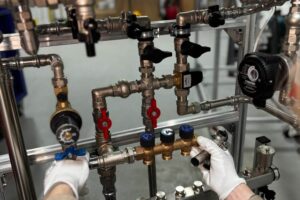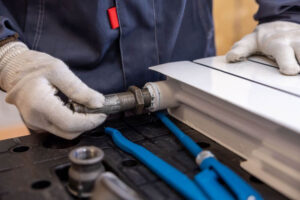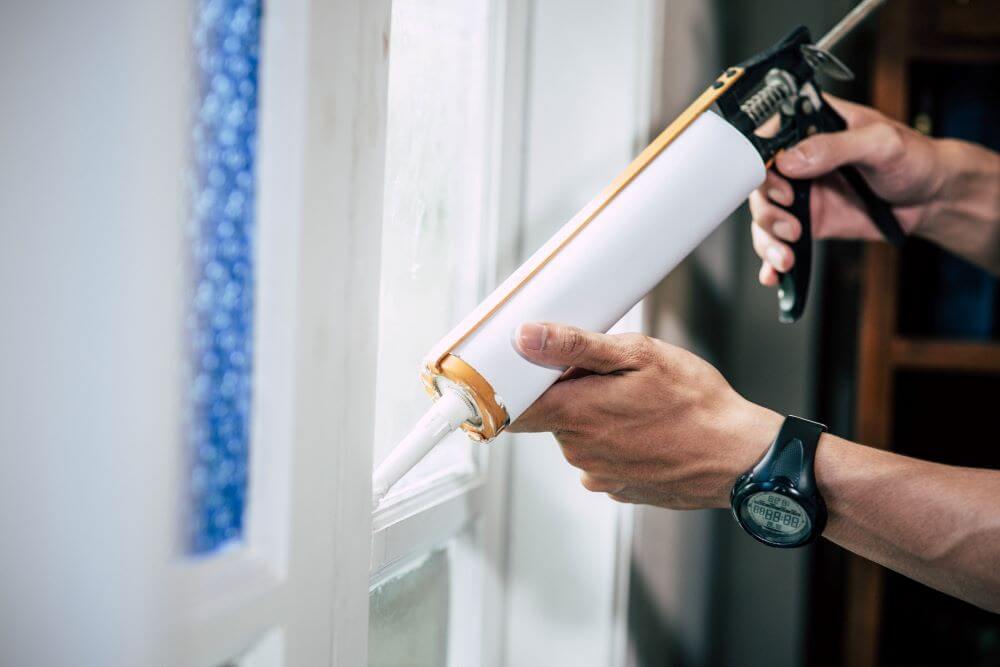
A fire-rated wall is only rated until someone drills through it. On a typical commercial floorplate, that happens several hundred times every cable tray, conduit, chilled water line, drainage stack, and ductwork run that crosses a compartment boundary is a deliberate hole in a barrier whose entire purpose is to be continuous.
Firestopping is the discipline of restoring that continuity, and fire-rated sealant is the most common tool for doing it. It’s also, on a lot of projects, the element handled with the least rigour specified late, installed by whichever trade got there last, and inspected only if someone insists.
What the Rating Is Actually Measuring
A fire-rated sealant carries a resistance period commonly one, two, three, or four hours describing how long a correctly installed seal maintains performance under standardised fire test conditions. Two criteria matter.
Integrity (E). The seal prevents flame and hot gases from passing through to the unexposed side.
Insulation (I). The seal limits temperature rise on the unexposed face, so combustible material touching the other side of the wall doesn’t ignite from conducted heat.
A product may achieve a longer integrity period than insulation period, and the two are quoted separately in a proper classification. A single unqualified “4 hours” on a datasheet is the start of a conversation, not the end of one.
The critical point that gets missed: the rating belongs to the tested assembly, not to the tube. A sealant is tested as part of a specific configuration: a particular substrate, wall construction, opening size, penetrating service, annular gap, and seal depth. Install the same sealant around a different service in a different wall type and you are outside the tested scope, whatever the label says.
Why M&E Penetrations Are the Hard Case
Firestopping a plain construction joint is comparatively simple. M&E penetrations are harder for reasons structural to how services behave in a fire.
Metallic services conduct heat. A steel pipe crossing a compartment wall carries heat to the unexposed side regardless of how well the annular gap is sealed. Insulation performance around metal penetrations often requires measures beyond sealant alone.
Plastic services disappear. PVC and PE pipes soften and melt early in a fire, leaving an open hole exactly where the barrier was. Sealant cannot close a void that forms after the fire starts plastic penetrations need intumescent collars or wraps that expand to crush the softening pipe closed. This is one of the most consequential specification errors in the field, and it is common.
Cable bundles are not solid. A tray carrying two hundred cables has air paths running through the bundle itself. Sealing the perimeter leaves the interstitial gaps open unless the seal is designed to penetrate the bundle.
Services move. Thermal expansion, vibration from pumps and AHUs, and settlement all work the seal over the building’s life. A rigid firestop that cracks after two years of duct vibration provides a rating on paper only.
Services get added. The single most common cause of firestopping failure isn’t installation quality; it’s the cable pulled through eighteen months later by a contractor who has no idea the wall was rated, and no instruction to reinstate the seal.
The Specification Checklist
For a specifier or M&E consultant reviewing a firestopping submission:
- Classification report, not a datasheet. Check the tested configurations against the ones actually on the project.
- Match the rating to the barrier. The seal must equal or exceed the fire resistance of the wall or floor it penetrates. A two-hour seal in a four-hour wall downgrades the whole compartment.
- Right product for the service type. Sealant for annular gaps around non-combustible services; intumescent collars or wraps for plastics; specified systems for cable bundles and insulated pipework.
- Movement accommodation where services or the structure will move.
- Interior firestop seals are frequently painted over to confirm the product tolerates it, as some fire-rated silicone and acrylic formulations are specified as paintable and others are not.
- Documentation and labelling. Unlabelled firestops cannot be inspected, maintained, or correctly reinstated.
Where Fire-Rated Sealant Fits in a Wider System
Sealant is one component of a firestopping strategy rather than the whole of it. A complete approach generally combines fire-rated sealant for annular gaps and linear joints, intumescent collars and wraps for combustible services, boards and batts for large or irregular openings, and mortar or compound for heavily populated openings.
Sourcing these from a coordinated range rather than assembling them ad hoc has a practical advantage beyond convenience: the test evidence is more likely to cover the combinations you are actually building, and there’s a single supplier accountable when an inspector asks for documentation.
The Maintenance Gap
Firestopping is close to unique among building elements in that it is installed once, concealed immediately, and then routinely destroyed by ordinary building operations. Every IT refresh, every tenant fit-out, every new chilled water branch is an opportunity for a compliant seal to become a hole.
Two things reduce the damage: legible labelling at every penetration so subsequent trades can see what they’re cutting into, and a stated reinstatement obligation in fit-out and maintenance contracts. Neither is expensive. Both are more effective than any specification decision made at design stage, because the seal that actually matters is the one still intact in year seven.
Practical Takeaways
- The fire rating belongs to the tested assembly, not the product check configurations, not labels
- Ask for the classification report; a datasheet is not evidence
- Plastic services need intumescent collars, not sealant the most common serious error in the field
- Match seal rating to the barrier it penetrates, or the whole compartment is downgraded
- Label every penetration so later trades know what they’re cutting into
- Write reinstatement obligations into fit-out and maintenance contracts
Where to Start
For M&E consultants and specifiers assembling a compliant package, Fire-rated sealant, M&E standard sits alongside collars, wraps and boards in First Sealant Technology’s Protecta fire safety system range, together with the company’s own FR-5 Firesil silicone sealant specified for fire resistance of up to four hours, paintable, and rated for interior and exterior use. The useful question when reviewing any such range is which specific tested configurations are covered, because that determines whether a product is compliant on your project or merely plausible.
For test documentation and classification reports, their team can be reached at 096-818-9168, 097-959-5111, or 097-959-1222, Monday through Saturday, 08:30–17:30.