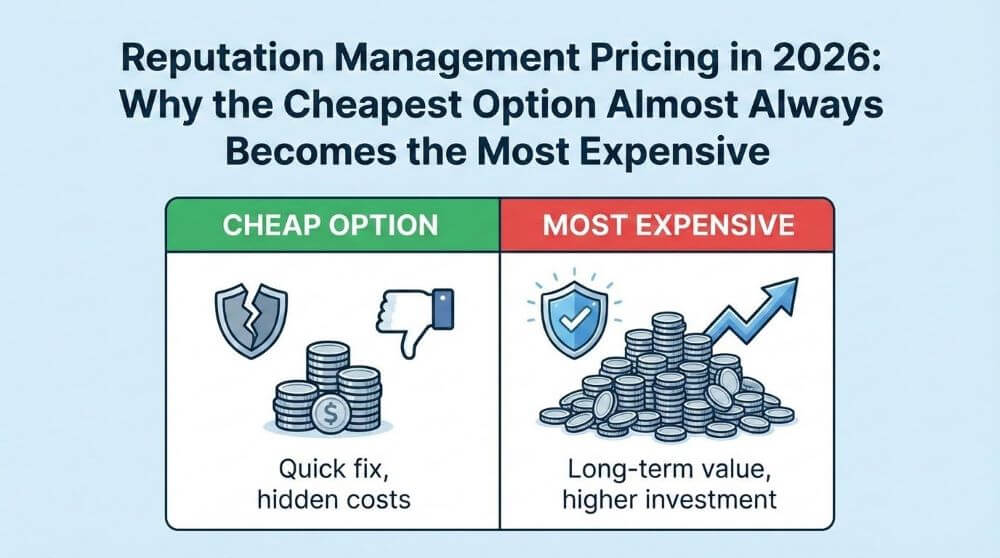
A few years ago, paying $10,000 for reputation help might have sounded excessive. In 2026, that same decision could be the difference between staying stable and cleaning up a six-figure mess later.
I’ve seen businesses go the “affordable” route, thinking they were being smart, only to spend five or ten times more fixing what that cheap solution broke. That pattern isn’t rare anymore. It’s becoming the norm.
Reputation management pricing looks lower on the surface today. AI tools, automation, and bundled services have driven down entry-level costs. But what you’re really paying for has quietly changed. And that’s where things go sideways.
The Price Tag Isn’t the Problem. The Scope Is.
A $150 monthly plan sounds like a win until you realize what it actually covers.
Most low-cost services are built around volume, not protection. They monitor a handful of platforms, rely heavily on templates, and react slowly when something starts to spread. That might be enough when nothing is happening. It fails the moment something does.
The issue isn’t just that these services are limited. It’s that they create blind spots. Negative content doesn’t disappear because you didn’t see it. It spreads faster.
And when you finally catch it, you’re no longer paying for management. You’re paying for damage control.
That’s where the math flips. What looked like savings turns into compounding cost.
Quick Fixes Don’t Hold Up Under Pressure
Many cheaper providers lean on shortcuts. Bulk reviews. Automated responses. Incentivized feedback. On paper, it looks effective. You might even see a short-term lift.
But platforms have gotten better at spotting patterns. And regulators have gotten stricter about what’s allowed.
When those shortcuts get flagged, the fallout is immediate. Listings get suspended. Reviews get removed. Trust drops overnight.
Now you’re not just rebuilding your reputation. You’re rebuilding your credibility with the platforms themselves.
That’s a much harder and more expensive problem to solve.
AI Made Pricing Cheaper. It Also Made Mistakes Faster
AI is a big reason reputation management pricing looks more accessible in 2026. It can monitor mentions, generate responses, and even create content at scale.
But it still doesn’t understand context the way a human does.
It misses tone. It misreads intent. It treats a serious issue like a routine complaint, or worse, responds in a way that escalates the situation.
That’s fine when you’re dealing with low-stakes feedback. It’s a problem when your brand is under pressure.
Automation without oversight doesn’t just fail quietly. It fails publicly.
Bundles Make Things Look Complete When They’re Not
Many services now come packaged as “all-in-one” solutions. Monitoring, reviews, social, maybe even some SEO. It sounds comprehensive.
Until you look closer.
Coverage is usually limited. Certain platforms are excluded. Legal support isn’t included. Crisis response is either slow or nonexistent.
What happens next is predictable. You start adding features. Expanding coverage. Upgrading plans.
Before long, the “affordable” package costs more than a properly structured service would have from the start.
The difference is that now you’ve already lost time, momentum, and in some cases, trust.
Where Cheap Gets Expensive Fast
Reputation issues don’t stay contained. They escalate.
A negative review turns into a thread. A thread gets picked up elsewhere. A single complaint becomes a pattern in search results.
Without real monitoring and fast response, that timeline moves quickly.
Day one, it’s manageable.
By day three, it’s visible.
By the end of the week, it’s affecting decisions.
At that point, the cost isn’t just what you pay a provider. It’s lost revenue, lower conversion, and long-term brand damage.
And if legal issues are involved, the stakes get even higher.
Compliance Isn’t Optional Anymore
There’s also a legal side that many low-cost services ignore.
Review gating, fake testimonials, and manipulated feedback aren’t just risky; they’re illegal. They’re actively enforced now.
If your provider cuts corners here, you’re the one who deals with the consequences.
Fines, takedowns, account restrictions, and long-term visibility issues aren’t hypothetical anymore. They’re happening.
And fixing that isn’t a quick process.
When Things Go Wrong, Recovery Is Expensive
One of the biggest misconceptions about reputation management pricing is that you can always “fix it later.”
Technically, yes. Practically, it’s far more expensive.
Once your listings are flagged or your content loses trust signals, recovery takes time. It takes strategy. It takes consistency.
You’re rebuilding authority, not just cleaning up content.
That’s why businesses that start with low-cost solutions often end up investing heavily in professional services later anyway.
The difference is that now they’re starting from a worse position.
What You’re Actually Paying For at Higher Price Points
When you move into higher-tier services, the shift isn’t just in price. It’s an approach.
You’re not paying for more volume. You’re paying for depth.
Real monitoring across platforms.
Faster response times.
Custom strategies instead of templates.
Legal awareness is built into the process.
And most importantly, someone who knows when something is about to become a problem before it actually does.
That’s what changes the outcome.
Companies like NetReputation, for example, don’t just respond to issues. They structure protection around how problems typically develop, not just how they appear.
That difference matters more than most people realize at the beginning.
The ROI Conversation Most People Skip
If you view reputation management pricing solely as a monthly cost, the cheaper option will almost always win.
But that’s the wrong lens.
The better question is what happens over time.
How does it affect customer trust?
How does it impact conversion?
What does it cost if something goes wrong?
When you factor in customer lifetime value and risk, the numbers shift quickly.
A stronger reputation increases both retention and acquisition. A damaged one does the opposite.
That gap is where real ROI lives.
Pricing in 2026 Isn’t About Cheap vs. Expensive
It’s about alignment.
A small business with limited exposure doesn’t need enterprise-level protection. But it still needs enough coverage to avoid blind spots.
A growing company can’t rely on entry-level tools anymore. The risk is too high.
And at the enterprise level, reputation is directly tied to valuation, partnerships, and long-term growth.
That’s why pricing tiers exist. Not to upsell, but to match risk with protection.
The mistake is choosing based on cost instead of exposure.
Why the Cheapest Option Keeps Losing
At the end of the day, the cheapest option fails for a simple reason.
It’s built to manage tasks, not outcomes.
Reputation isn’t a checklist. It’s a moving target. It changes with search behavior, platform rules, and public perception.
If your strategy can’t adapt, it breaks.
And when it breaks, you don’t just go back to where you started. You fall behind.
That’s why, in 2026, reputation management pricing isn’t really about what you pay upfront.
It’s about what you’re willing to risk later.